In the mid‑90s, PC games were evolving fast. The CD‑ROM replaced floppies, 3D graphics were starting to sneak into our desktops, and gamers were eager for new experiences. Yet many classic PC games that delivered original ideas slipped through the cracks, and today few talk about them. For instance, a well‑curated game list of legendary 90s PC games shows dozens of great adventure game titles that are rarely mentioned in modern retro gaming conversations.
What this means is that beyond the household names like Doom, Half‑Life, and StarCraft, there are hidden gems worth revisiting. This blog highlights three such titles from the legendary 90s PC games era, games that stood out then but slipped from mainstream memory lane.
What made legendary 90s PC games special
The legendary PC games offered a mix of experimentation and risk. Developers were willing to try odd settings, hybrid mechanics, and ambitious scale because original hardware was improving and the market was hungry for novelty. The consequence: some titles pushed boundaries that consoles of the time simply could not. For example, open‑ended role‑playing, grand space exploration, or first-person shooters in less usual genres. But with that experimentation came uneven commercial success, and many games got overshadowed by blockbuster hits. The point here is that the titles discussed below did something different. They were not necessarily the most popular at the time, but they merit attention for their creativity, ambition, and how they hint at what game development could do.
Game pick 1: Darklands (1992)
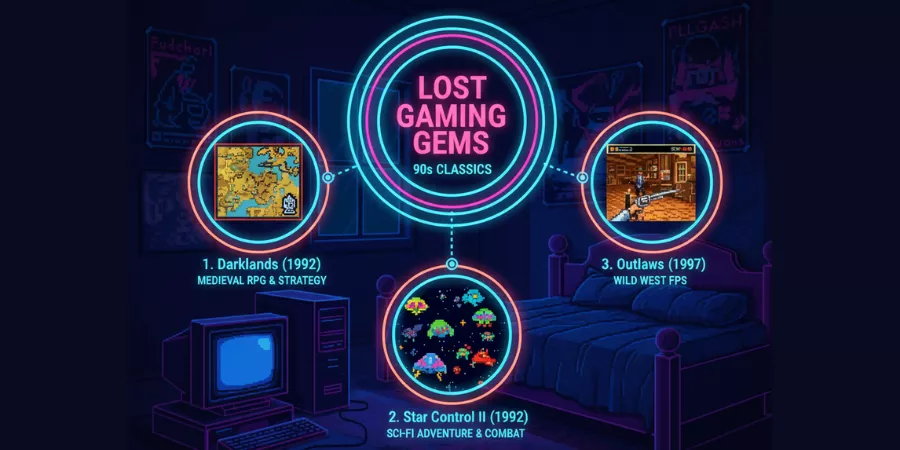
Released by MicroProse for MS‑DOS, Darklands drops you into 15th‑century Germany, mixing historical setting with myth and alchemy. You form a party of adventurers, travel across cities, delve into mines, and face robber‑knights, witches, and supernatural forces. The mix of realistic medieval geography and fantasy elements made it stand out. What many skipped over at the time: the game was buggy, distribution was limited, and the interface was complex for casual players.
Today it can feel slow, but for its era it offered an open‑ended RPG experience that few adventure game classic PC games attempted. It invites the modern player to slow down, appreciate the atmosphere, and see where game narrative was heading. If you enjoyed sprawling genre-shaping RPGs later on, you might find in Darklands the roots of that feel.
Game pick 2: Star Control II (1992)
From developers Toys for Bob, this MS‑DOS adventure game combined action, adventure, diplomacy, and space exploration. You control a spaceship in a galaxy full of alien races, landing on worlds, negotiating or fighting, upgrading your craft, and uncovering a grand narrative. Despite earning critical acclaim, the game did not maintain mainstream visibility as newer titles overtook it. A Reddit commenter put it well:
“It warms my heart to know that… [even] 9‑year‑olds can still enjoy it.” What this adventure game really delivers is a sense of scale, freedom, wit, and ambition that many modern open world games aim for but seldom deliver so fluidly. Revisiting it now offers a window into how much scope classic legendary PC games had, if you were willing to invest the time.
Game pick 3: Outlaws (1997)
Developed by LucasArts, Outlaws is a first-person shooters set in the American Wild West. You play as ex‑Marshal James Anderson on a revenge quest against outlaws who killed his wife and kidnapped his daughter. Compared to contemporaries like Quake II, the graphics engine was less flashy. But the game introduced mechanics that were ahead of their time: gun reloading, sniper zooming, cinematic cut‑scenes, and atmospheric setting. For many players it was overlooked because the market was saturated with shooters, and the Wild West theme didn’t attract the same mass audience as sci‑fi. Today, with remaster efforts underway, it presents itself as a “lost” classic PC games, one that gamers who love genre‑bending shooters should rediscover.
Why these games faded from popular memory
Here are some reasons why even worthy games like these became less talked about:
- They were overshadowed by massive hits with bigger marketing budgets and wider reach, including titles like Age of Empires, Command & Conquer, Warcraft II, Red Alert, and Diablo 2.
- Some pushed ambitious gameplay mechanicsbut lacked polish or user‑friendliness for casual audiences, making them less accessible for the family PC
- Hardware and operating‑system changes made them harder to run or maintain, so they became inaccessible. Antivirus softwareupdates also sometimes conflicted with older Windows PC
- Nostalgia tends to focus on the mainstream hits; those who miss the niche titles often lose them to time. LAN parties and online multiplayersessions kept some titles alive, like Red Alert and Command & Conquer, but overall exposure diminished.
Takeaway
If there is one thing that you should remember from this article, it is the fact that the past of video games is much more varied than the mere enumeration of big-name releases. The early legendary 90s PC games period was the ground where one-off experiences were, at times, even more than what the world was ready for.
The replay of games such as Darklands, Star Control II, and Outlaws gives you a chance to notice how the ideas that are now a part of the game’s vocabulary were already taking shape, and often in very surprising places, thirty years ago. PC games like Baldur’s Gate, Fallout 2, Jagged Alliance 1/2, Ultima Underworld, and Sims City 2000 offer a glimpse into virtual worlds, resource management, and intricate level design.
This is the era of first-person shooters, point-and-click adventures, adventure game exploration, and real-time combat experimentation. Fans of arcade-style sports game, Call of Duty, Star Wars : Dark Forces, Total Annihilation, Diablo 2, Ultima Underworld, and Red Alert might also rediscover LAN parties, online multiplayer titles, and 3d/Polygonal gameplay. Some even experimented with Mode 7, Metroid Prime, Sega Genesis, Super Mario World, and Mortal Kombat, leaving footprints of childhood wonder and original hardware nostalgia.
Players who opt for legendary 90s PC games again are basically taking a look at the early game design, the game engine innovations, and the artificial intelligence experimenting that are still part of the modern games to a certain extent. These games like Baldur’s Gate, Civilization II, Warcraft III, DotA AllStars, and Freddi Fish are unavoidably reminding us of the vastness of the gaming world. The payment method, the online playing feature, and the series of games’ advancements are indicators of the reasons why some games are still recognized as the best in gaming history.
For those longing for memory lane, Nintendo Switch, Xbox One, Street Fighter II, Dragon Quest VIII, Final Fantasy X, Fire Emblem: Path of Radiance, Legendary Eleven, Legendary Eleven, Legendary Eleven, Legendary Eleven, and Legendary Eleven are perfect starting points. Whether you enjoy Arc Raiders, Tiny Lands 2, Kelp Seeds, or The Legend of Zelda, these classic PC games reveal how Western developed games, Open world games, and 3D icons shaped what we now call the Game of the Decade.
The joy of rediscovery is one of the best parts of being a gamer, and spending time with these legendary 90s PC games can reignite passion for city planning, resource management, graphics engine, and game development, all while appreciating the foundations of online multiplayer, Level design, and classic PC games craftsmanship.